Sunderland AFC have a grand history as one of the most successful football clubs in England with various league titles but debate exists over the start of the Black Cats’ illustrious story.
Club name
James Allan announced the creation of Sunderland AFC in September 1879 under the name Sunderland and District Teachers’ Association Football Club. But the team shortened their tag just one year later to remove the mention of teachers after allowing non-academics to join. September 1880 also marks the date that Allan announced that Sunderland were ready to play competitive games.
It was not until February 2000 that Sunderland embraced their nickname, the Black Cats. A black cat had been a symbol of the Wearside natives for years before the club held a poll among fans. The name got 48% of the 10,000 votes cast, beating the Mackems at 37%.
Sunderland AFC badge
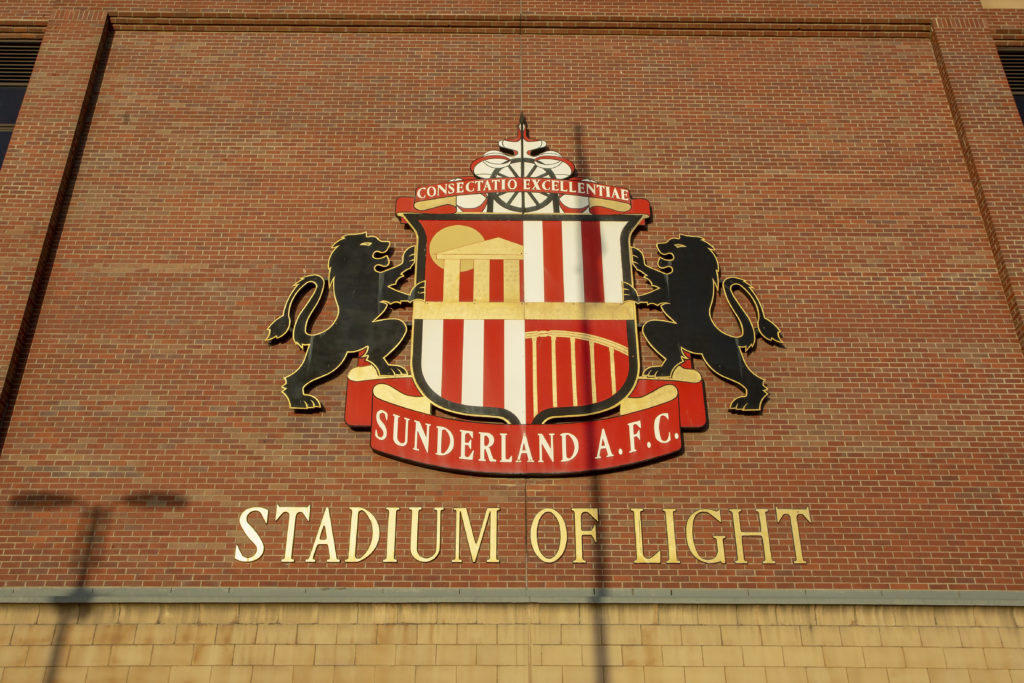
Sunderland adopted their current badge in 1997 for the sixth unique design in the club’s history so far. The Black Cats modified the crest’s design with a gold outer shield during the 2009/10 season, while a red silhouette also bordered the main design over the 2018/19 term.
The badge first embraced in 1997 also celebrated Sunderland’s move from Roker Park to the Stadium of Light. It has two lions supporting a shield divided into four segments. The top left corner has the Penshaw monument and the lower right zone boasts the Wearmouth Bridge.
Sunderland also included their Latin motto of ‘Consectatio Excellentiae’, meaning ‘Pursuit of Excellence’, on their badge in 1997. Additionally, the crushing wheel behind the motto was a tribute to the Stadium of Light being built on the old site of the Monkwearmouth coal mine.
Prior to their current badge, Sunderland embraced a more basic shield as their crest in 1977 that they altered slightly in 1991. The Black Cats swapped the blue background in the upper segment which housed a ship to black. It retained the classic football with the club’s initials.
An even more basic crest adorned Sunderland’s history from 1973 to 1977, as well. The club simply used their initials in a cascading line for four years having used just a large S followed by AFC from 1966 to 1973. The designs were the club’s first badges without a shield aspect.
Sunderland adopted the first badge in their history as a club in 1913 with a white shield that borrowed aspects of the city’s coat of arms. It contained a knight’s helmet, feathers, a globe, a ribbon and the Latin motto, ‘Nil Desperandum Auspice Deo’. It remained in use until 1937.
A second shield design followed from 1937 to 1966 as Sunderland adopted a blue crest with red and white lines surrounding the badge. The crest also retained the Latin motto, meaning ‘Don’t despair, in God we trust’, but changes followed as Sunderland sought a simple design.
Kit history
Red and white striped kits are synonymous with Sunderland AFC’s history as a football club but the team only adopted their traditional colours in 1884 after wearing all navy blue originally. The Black Cats further only adopted a striped shirt for the first time come 1887.
Sunderland actually used two-tone halved shirts for their first three years in red and white jerseys. They further retained navy blue shorts and socks until the first striped shirt in their history, accompanied by white shorts. The club’s first pair of black shorts also debuted in 1888.
League history

Sunderland AFC made English Football League history in 1890 when the EFL voted the Black Cats into its division. They replaced Stoke City for the third season of the competition’s time in existence. A debut title then followed a year later as Sunderland took the 1891/92 crown.
Funding from wealthy directors in the coal and shipbuilding industries saw Sunderland sign several star players, too. Their squad, dubbed ‘the team of all the talents’, were then a dominant side at the birth of Division One and added further titles in 1892/93 and 1894/95.
Being the inaugural winners of Division One added another string to Sunderland’s bow after becoming the first side voted into the Football League just two years earlier. Relegation nearly beckoned in 1896/97, only surviving via a test series with the top Division Two clubs.
The 1896/97 season was to be a rare blip as Sunderland returned to the top end of the table straight away. Another title also arrived in 1901/02 before they had to wait until 1913 to lift the crown again. Sunderland won their next and most recent top-flight title in 1936.
Glory has since escaped the Wearsiders – who later endured relegation for the first time come 1957/58. It took them six seasons to re-join Division One but their stay would not be as long lived. Another relegation to Division Two followed in 1970 and they continued to yo-yo after.
Worse was still to come for Sunderland, too, as they found themselves in Division Three for the first time in 1987/88 but it would only be for a season as they swept the title. Another promotion followed in 1990, yet relegation saw them miss the birth of the Premier League.
Sunderland eventually joined the Premier League in 1996 after taking the Division One title but, even after winning 10 of their 38 games, relegation beckoned straight away by a point to Coventry City. Another yo-yo spell then ensued before becoming top-flight mainstays again.
Kevin Phillips helped Sunderland be a Premier League regular
Kevin Phillips helped Sunderland cement a place in the Premier League from 1999 to 2003. His goals took the Black Cats to seventh-place finishes in 1999/2000 and 2000/01 although even he could not prevent relegation and second-tier football was on the menu once again.
Sunderland eventually proved themselves as Premier League mainstays from 2007 to 2017 but they only finished in the top half of the table once during those 10 seasons – 10th in 2010/11. David Moyes resigned on the back of finishing the 2016/17 term in 20th and last place.
Things would only get worse for Sunderland, though, as another relegation followed straight away. The Black Cats would call the third tier their home for the first time in 30 years during the 2018/19 season. It also took them four seasons to find a way back to the Championship.
Second-tier football eventually returned to Wearside in 2022 as Sunderland, finally, won the League One play-offs. They beat Wycombe Wanderers 2-0 at Wembley after losing the final to Charlton Athletic in 2019 and Lincoln City in the 2021 semi-finals.
Sunderland AFC trophies
Sunderland AFC are one of the most successful clubs in English Football League history as a once-dominant top-flight force. Few can rival the Black Cats’ success in the top tier around the end of the 19th century but Sunderland’s trophy cabinet lacks recent major honours.
Managers have brought lower-tier titles back to Wearside in more recent seasons, however, they last topped the first division in 1935/36 and last won the FA Cup in 1972/73. Sunderland beat Leeds United in the 1973 FA Cup final at Wembley to deny the Whites back-to-back medals.
Players and managers

The highs and lows that litter the Black Cats’ history have produced a host of Sunderland AFC legends. What Phillips delivered at the Stadium of Light in particular around the turn of the 21st century cemented the striker’s place in Wearside folklore as a goalscoring legend.
Phillips was prolific in red and white, even winning the European Golden Boot in 1999/2000. He scooped the award as Europe’s top scorer after taking the Premier League Golden Boot with 30 goals. His 23 goals had only just fired Sunderland to the second-tier title in 1998/99, too.
Other Sunderland legends include Phillips’ little-and-large strike partner, Niall Quinn. He led the Black Cats line as a dominant aerial force when others thought his career was over after leaving Arsenal. Quinn was also not just a basic target man with his elegant play on the ball.
Lethal goalscorers litter the top legends in Sunderland’s history as a club with Bobby Gurney as another. He joined the Black Cats in 1925 yet was still going strong 25 years later before the forward retired in 1950. The attacker’s efforts were particularly vital for their 1936/37 title.
Managers also have their place in the pages of Sunderland’s history books, potentially none more so than their first: Tom Watson. He took over when the Black Cats turned professional in 1886 and his six seasons in charge delivered three top-flight titles with a 62.3% win rate.